I
ntroduction
L
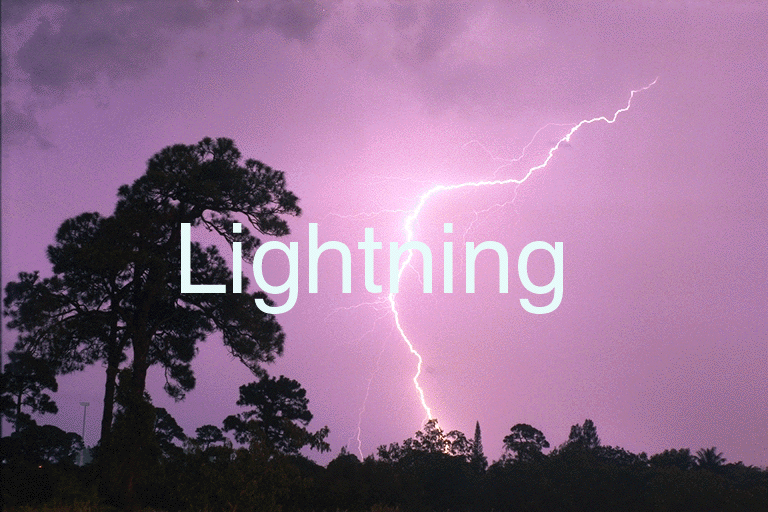
ightning, the thunderbolt from mythology, has long been feared as a weapon of the gods. Today, scientific rather than mystical ideas are used to explain lightning.Particles within a cloud grow and interact, some become charged through collisions. The smaller particles tend to acquire positive charge, while the larger particles acquire more negative charge. These particles tend to separate under the influences of updrafts and gravity until the upper portion of the cloud acquires a net positive charge and the lower portion of the cloud becomes negatively charged. This separation of charge produces an enormous electrical potential both within the cloud and between the cloud and ground. This can add up to millions of volts, and eventually the electrical resistance in the air breaks down and a flash begins. Lightning, then, is an electrical discharge between positive and negative regions of a thunderstorm. Lightning is responsible for many deaths and millions of dollars in property every year.
Globally, about 100 lightning flashes occur each second, and in an average year in the United States there is about one lightning flash every second. On the Apollo 12 mission lightning briefly stopped all of the electronics onboard. Luckily, the astronauts regained control of the ship.
A lightning flash is composed of a series of strokes with an average of about four.
H
istory

B
enjamin Franklin, the "first electrical engineer" performed the first study of lightning during the second half of the 18th century. In that time, electrical engineers had developed a machine where positive and negative charges could be separated. Those electrical machines could, by rubbing together two different materials, store the charges in primitive capacitors called Leyden Jars. In those jars sparks could be generated and observed.
Benjamin Franklin was the first to design an experiment that conclusively proved the electrical nature of lightning. In his experiment, he theorized that clouds are electrically charged, and that must mean that lightning is also electrical. The experiment involved Franklin standing in a thunderstorm on a conducting stand, and he would be holding an iron rod with one hand to obtain an electrical discharge between the other hand and the ground. If the clouds were electrically charged then sparks would jump between the iron rod and a grounded wire.
Franklin thought of a better way to prove his hypothesis by using a kite. The kite could reach a greater elevation and could be flown anywhere. During a Pennsylvania thunderstorm in 1752 the kite flew with sparks jumping from a key tied to the bottom of damp kite string to an insulating silk ribbon tied to the knuckles of Franklin's hand. Franklin's grounded body provided a conducting path for the electrical currents responding to the strong electric field buildup in the storm clouds.
Types of Lightning Discharges
The most common types of lightning
C
loud-to-ground lightning is the most damaging and dangerous of all lightning. It is not the most common type, but it is the one that is best understood. Most flashes start near the lower-negative charge center and send a negative charge to Earth. However, some flashes carry positive charge to Earth. These positive flashes often occur during the weaker stage of a thunderstorm's life. Positive flashes are also more common as a percentage of total ground strikes during the winter months.
Intra-cloud lightning is the most common type of discharge. This occurs between oppositely charged centers inside the same cloud. Usually the process takes place within the cloud and looks from the outside of the cloud that flickers.
Storms with the greatest vertical development may produce intra-cloud lightning. Scientists suggest that the variations are height- dependent, with a greater percentage of cloud-to-ground strikes occurring at higher latitudes.
Details of why a discharge stays within a cloud or comes to ground are not well understood.
Depending upon cloud height above ground and changes in electric field and the strength between the cloud and Earth, the discharge stays within the cloud or makes direct contact with the Earth. If the field strength is highest in the lower regions of the cloud a downward flash may occur from cloud to Earth.
O
ther types of lightningThere are numerous names and descriptions of various types and forms of lightning. Some identify subcategories, and others may arise from optical illusions, appearances, or myths. Some popular terms include: ball lightning, heat lightning, bead lightning, sheet lightning, silent lightning, black lightning, ribbon lightning, colored lightning, tubular lightning, meandering lightning, cloud-to-air lightning, stratospheric lightning, red sprites, blue jets, and elves.
M
ore about lightning related issues............T
hunderSound is generated along the length of the lightning channel as the atmosphere is heated by the electrical discharge to about 20,000 degrees Celsius (about 3 times the temperature of the surface of the sun). This compresses the surrounding air producing a shock wave, which then becomes an acoustic wave as it moves away from the lightning channel.
Although the flash and thunder occur at the same time, light travels at 186,000 miles in a second, almost a million times the speed of sound. Sound travels at the relatively snail pace of one-fifth of a mile in the same time. Thus the flash, if not obscured by clouds, is seen before the thunder is heard. By counting the seconds between the flash and the thunder and dividing by 5, an estimate of the distance to the strike (in miles) can be made.
R
ainWhen moist warm air is heated, it begins to rise. As these currents or bubbles of warm moist air rise higher in the atmosphere, both the surrounding air pressure and temperature is decrease. The air bubbles expand, causing cooling of the moisture which eventually condenses to form clouds. As the cloud cools further, more moisture condenses and the water droplets making up the cloud grow and merge until some become so large and heavy that the air currents within the cloud can no longer support them. These water droplets begin to fall as rain.
Description of lightning discharge processes
|
Description of lightning discharge processes |
- The lower part of a thundercloud is usually negatively charged. The upward area is usually positively charged.
- A breakdown of the air in a region of strong electric fields, leads to the creation of a streamer to begin to move downward toward the Earth in discrete steps of about 50 meters each. This streamer is called and is called a stepped leader.
- As the stepped leader grows, it creates a charged path depositing charge along its channel.
- As the stepped leader nears the Earth, a large potential difference is generated between the end of the leader and the Earth.
- Typically, a streamer is generated from the Earth and intercepts the descending stepped leader just before it reaches the ground.
- Once a connecting path is achieved, a return stroke flies up the already ionized path at close to the speed of light. This is actually what we see by our naked eyes.
- This return stroke releases tremendous energy, bright light and thunder.
|
Return stroke |
Occasionally, where a thunderstorm grows over a tall Earth grounded object, such as a radio antenna, an upward leader may propagate from the object toward the cloud. This "ground-to-cloud" flash generally transfers a net positive charge to Earth and is characterized by upward pointing branches.
--------------------------------------------------------------------------------
Lightning Investigations Using Rockets, High-Altitude Airplanes and Spacecraft
For many investigations, lightning must be observed from as close a vantage point as possible. One technique is to probe inside of hostile thunderstorms in order to study how thunderclouds electrify, but this does not ensure close-up encounters with lightning. Close-up measurements are difficult to obtain because of the unpredictability of where and when lightning will strike. Hence, methods have been developed to create lightning discharges under somewhat controlled conditions.
Rocket-triggered lightning research has been an important tool for close-up investigation.
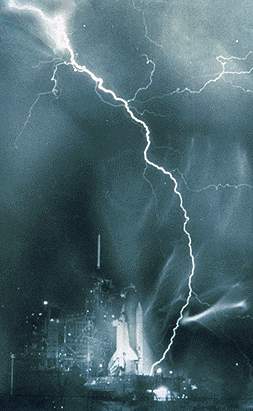
With this technique, small sounding rockets connected to long copper wires have replaced Franklin's kite. These rockets are launched into thunderstorms with electronic sensors located near the bottom end of the wire instead of a key. When the rocket is struck by lightning, the wire is vaporized.
Data collected before and during the occurrence of lightning provide detailed information of the discharge's characteristics. Sounding rockets can also provide in-cloud measurements of thunderstorms in a challenging environment. While extensive ground-based optical and electrical measurements of lightning have been made, the emphasis has been on cloud-to- ground discharges with little study of intra-cloud lightning being undertaken. This is partly due to the fact that optical measurements of in-cloud lightning are severely affected by light scattering from water droplets within the cloud. For this reason, ground-based measurements alone have not been considered an appropriate means for determining the optical characteristics of lightning as viewed from above.
In order to determine the requirements for making optical measurements from space, U-2 and ER-2 high altitude airplanes have been used to study the electrical and optical characteristics of lightning activity in thunderstorms. Flying at an altitude of 20 km and at speeds of 200 meters per second, they are capable of flying over very large thunderstorms.
Much has been learned from these aircraft observations. For example, they have confirmed C. T. R. Wilson's theory that strong electric fields over the tops of thunderstorms cause conduction currents to flow to the tops of clouds. The penetrative convective cells which rise above the anvil are the most active electric regions in the storm and cause the most intense electrical stresses, as seen from high altitude aircraft.
The ER-2 has a larger payload capability than its predecessor the U-2. Both have provided direct observations of severe thunderstorms and other clouds using multi-sensor payloads including lasers, infrared, visible, microwave scanners, spectrometers, and electric field antennas.
In addition, photography of lightning from above clouds has been accomplished using an open shutter technique. In this method, the camera is pointed toward the thundercloud with the shutter open. In the dark nocturnal sky, no light falls onto the film until lightning strikes. An example of an open shutter photograph from the U-2 is shown on the left. The illuminated storm cell depicts a convective cloud turret approximately 11 km in height and 12 km in diameter.
To compliment the optical measurements from aircraft, video lightning images have been taken during a number of space shuttle flights while conducting the Mesoscale Lightning Observation Experiment (MLE). These observations have revealed many interesting lightning events.
For example, on April 28, 1990, a video image from space showed a single stratospheric luminous discharge appearing to move upward into clear night air. This was recorded on the space shuttle STS-32 mission using the payload bay TV camera.
The direction of this event has not been firmly established, however, the strato-spheric discharge is of interest because it may provide evidence for a theory postulated by C. T. R. Wilson in 1925. This theory predicted that electric fields can cause ionization at great heights and could therefore give rise to discharges between clouds and the upper atmosphere.
Stratospheric lightning could potentially deposit significant energy into the stratosphere, causing important chemical perturbations. In addition, these lightning events may generate strong electric fields and electromagnetic pulses which might interact with the Earth's ionosphere and magnetosphere. Finally, strong fields at high altitudes may generate runaway electrons which could then produce high energy x-rays and even gamma rays. Thus, it is possible that lightning may generate electromagnetic radiation, ranging from extremely low frequency to gamma radiation.
Researchers from the Geophysical Institute at the University of Alaska have confirmed shuttle observations by capturing images on videotape of what appear to be brief flashes of light emanating from thunderstorms into the stratosphere. These "stratospheric optical flashes", also known as "red sprites", were photographed from NASA's DC-8 Airborne Laboratory while flying at an altitude of about l2 km during a night-time mission to videotape lightning over Iowa and Kansas during June and July of 1993. Stratospheric flashes are brief, persisting for less than about a tenth of a second. They appear to be associated with intense thunderstorm activity, but are both rare and fainter than typical cloud-to-ground or intra-cloud lightning. Unlike familiar ground level lightning events that are electrical discharges confined to narrow channels, the flashes appear to cover a relatively broad horizontal extent of several miles, and to extend to altitudes of perhaps as much as 95 km, or about 60 miles.
--------------------------------------------------------------------------------
Lightning Detection Networks (Ground-Based)
National and regional lightning networks which use magnetic direction finders, time of arrival techniques, or VHF interferometry, provide important lightning and storm information. For a number of years, the Federal Government assisted in the financing of a national lightning data service combining independently operated systems into one network. Used primarily for operational evaluation by NOAA, it evolved into a product with substantial value for both private industry and by other Federal agencies. By 1991, recognition of the importance of lightning detection had become apparent with economically viable commercially-sponsored systems coming into existence.
The National Lightning Detection Network (NLDN) which is operated by Global Atmospherics, Inc. (GAI) in Tucson, Arizona, is a network of at least 130 magnetic direction finders which covers the entire United States. Each direction finder determines a direction toward a detected electromagnetic lightning discharge. The location of the lightning discharge is determined by triangulation. Each of these sensors is capable of detecting cloud-to-ground lightning flashes at a distance of 400 km away and greater. Processed information is transmitted to the Network Control Center (NCC) in the form of a grid map showing lightning across the U.S.
The Atmospheric Research Systems, Inc. (ARSI) time-of-arrival (TOA) system provides 11 Lightning Position And Tracking Systems (LPATS) which cover the U.S. and extend hundreds of miles into both oceans and beyond the borders of Canada and Mexico. ARSI ground strokes lightning data includes information on latitude and longitude, date and time, polarity, and amplitude.
Recently, GDS purchased the ARSI system, and is in the process of combining the direction finding and time of arrival techniques into a single comprehensive network.
The TOA system operates by digitizing the waveform of a received lightning signal at each sensor and accurately timing the peak with a resolution of up to 100 nanoseconds. The difference of arrival time at four or more receivers is then used to calculate the location. The geographical positions of the various sensors making up the network are shown in the U.S. map.
Internationally, two very different types of lightning detection and location networks have been developed. The SAFIR two- dimensional VHF interferometer system developed by the French aerospace research organization ONERA and commercialized by Dimensions of France, is used to provide detailed information on all types of lightning activity within a relatively small area. The VLF Arrival-Time Difference (ATD) system designed and operated by the United Kingdom Meteorological Office, detects and locates lightning at very long range, but with less detection efficiency. In addition, other networks cover portions of Europe, Asia, Australia, China, and Canada.
--------------------------------------------------------------------------------
Global Studies
Global lightning signatures from the Defense Meteorological Satellite Program (DMSP) Optical Linescan System (OLS) have been analyzed from the filmstrip imagery which is archived at the National Snow and Ice Data Center in Boulder, Colorado. These signatures show up as horizontal streaks on the film images. The location of each of these streaks has been digitized in order to develop a preliminary database of global lightning activity.
While the database continues to be enlarged. the available data are spotty, making a comprehensive history of global lightning behavior impossible to produce. However, direct digital OLS data are becoming available now which will greatly improve and expand the global lightning database which is an important reference dataset.
Lightning annual, interannual , and seasonal variations could then be compared with other global sets (e.g. precipitation; global and regional synoptic patterns) both to improve understanding of the role of lightning on a global basis and to use lightning as an indicator of global change.
--------------------------------------------------------------------------------
The Global Electric Circuit
During fair weather, a potential difference of 200,000 to 500,000 Volts exists between the Earth's surface and the ionosphere, with a fair weather current of about 2x10-12 Amperes/meter2. It is widely believed that this potential difference is due to the world-wide distribution of thunderstorms.
Present measurements indicate that an average of almost 1 Ampere of current flows into the stratosphere during the active phase of a typical thunderstorm. Therefore, to maintain the fair weather global electric current flowing to the surface, one to two thousand thunderstorms must be active at any given time. While present theory suggests that thunderstorms are responsible for the ionospheric potential and atmospheric current for fair weather, the details are not fully understood.
Ground-based radio frequency measurements of global rates have significant uncertainties and limitations. A high resolution space-based sensor is necessary in order to help eliminate some of the present uncertainties associated with measuring global lightning activity.